Sketch First or Write First?
Sketch first or write first? Choose the medium that exposes your next decision, then use a clear switch point to turn an early hunch into usable work.
The common mistake with sketch first or write first is picking a side before identifying what the idea needs to reveal. A tidy paragraph can disguise a weak composition; a lively sketch can sidestep what the image is meant to say. Start with the medium that makes the unresolved decision visible.
Match the first medium to the problem
A sketch makes spatial decisions visible. It shows relative size, direction, overlap, rhythm and the awkward gap between two forms. A few rectangles on scrap paper can expose a composition problem that several polished sentences would politely leave alone.
Writing makes verbal decisions visible. It asks what the idea is about, what it leaves out and how one part relates to another. A rough sentence can reveal that a visual concept depends on a subject, audience or point of view that has not been chosen.
If you cannot picture the arrangement, begin with a sketch. If you can picture it but cannot explain why it matters, begin with words. When both are unclear, make one small mark or write one plain sentence, then see what question it raises.
Use the material that exposes uncertainty
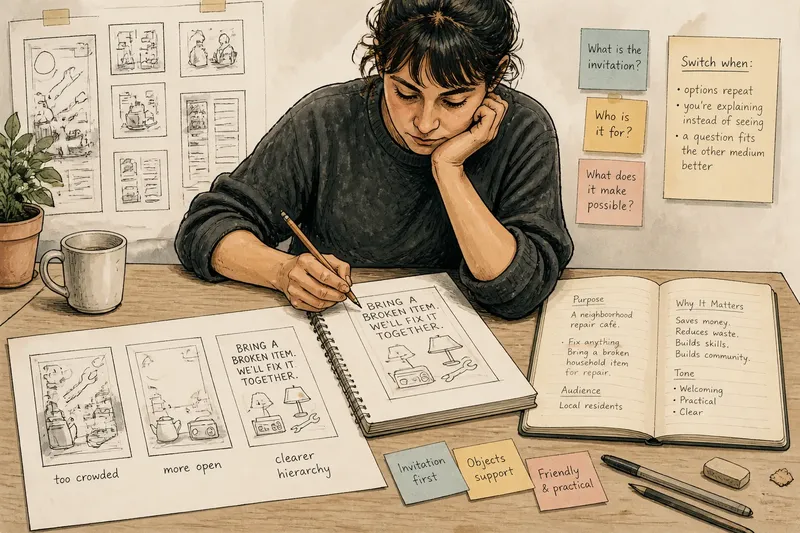
Drawing is useful when the idea concerns appearance or relation. Use a soft pencil, a marker or the shapes tool in Procreate. Keep the marks quick and spare. The aim is to make alternatives legible, not to demonstrate drawing skill. A row of thumbnails can compare a crowded centre with an open edge before either becomes a finished image.
Writing is useful when the idea concerns sequence, motive or emphasis. A notes app, index card or plain text document will do. Try fragments rather than a polished opening: a verb, a setting, a contradiction or a line of dialogue. Fragments can make a hidden assumption easier to question than a fluent paragraph, which has a way of dressing uncertainty in a tidy coat.
Notice what the first medium makes easy. A page covered in compositions may be avoiding the choice of subject. A page covered in explanations may be avoiding the first visual commitment. Ease is information, though not always a recommendation.
Switch when the first medium stops helping
Stay with the opening medium while it produces genuinely different possibilities. Switch when each attempt is only a cleaner version of the same answer, or when you are explaining away a problem that the page can show plainly.
Say you are shaping a poster for a neighbourhood repair café. Your first sketch gives the title, a spanner and several small objects equal weight. You write, “Bring a broken household item for repair.” That sentence clarifies the invitation. You sketch again, making the invitation larger and grouping the objects below it. The expected result is a clearer visual hierarchy: the sentence names the purpose, and the revised sketch lets you judge whether the eye finds it.
The reverse move works too. If a written scene feels lifeless, sketch where the people stand, what sits between them and where the light falls. Those marks may expose tension or show that the scene has no physical reason to continue. The drawing need not enter the final work to have done its job.
Choose a starting point for the kind of idea
These are tendencies, not rules. A subject can need both forms, and the useful starting point may change as the idea develops.
- Composition or layout: Check whether scale, spacing or visual order is unresolved. If so, sketch several arrangements; if the main uncertainty is the message, write a sentence about it first.
- Argument or explanation: Check whether the claim and its sequence are clear. If not, write the claim and its supporting points; if the argument depends on a visual arrangement, sketch that relationship as well.
- Character or scene: Check whether desire or physical position is unclear. If motive is unclear, write what the character wants; if movement or distance is unclear, draw a quick map of the scene.
- Pattern or repeated form: Check which feature changes and which stays fixed. If that distinction is unclear, sketch variations side by side; if the rule behind them is unclear, write it in a short phrase.
- Ambiguous subject: Check whether one interpretation has taken over too soon. If so, write two competing descriptions before choosing an image; if the descriptions remain abstract, sketch one object or action from each.
- Work combining text and image: Check whether the words or picture are controlling the meaning. If the caption feels too narrow, revise it; if the image feels too broad, sketch a more specific version before settling either form.
Which medium should you begin with?
Should I sketch first if I cannot describe the idea?
Try a rough image if the idea involves a visible arrangement, object or action. Label unclear parts in the margin instead of polishing the marks.
Should I write first if I lack confidence in drawing?
Begin with words if they help you identify the subject or intention. If the work depends on visual relationships, boxes, arrows and circles can still answer practical questions without becoming a drawing lesson.
Can I switch between writing and sketching?
Yes. Switch when one form stops producing new decisions or raises a question better suited to the other. Keep the earlier attempts nearby so the change does not erase what you learned.
What if neither approach produces a useful idea?
Make the prompt smaller. Describe one object, action or constraint, then draw or write only that part. A narrow starting point gives you something concrete to alter.
Keep the first attempt easy to revise
Use a loose sheet, a duplicate digital canvas or a disposable note. Label exploratory versions with brief phrases such as “more open”, “closer view” or “less explanatory”. These labels record the decision under consideration, not a judgement about whether the work is good.
Set a modest boundary: one page, a row of thumbnails or a handful of rough sentences. Stop when the options begin to repeat, not when the work looks finished. Then choose the next question: what must become clearer, more convincing or more visible?
For sketch first or write first, choose the medium that exposes the next decision with the least disguise. Keep the other close at hand. The second form is not an admission that the first failed; it is often where the idea finally has to answer back.